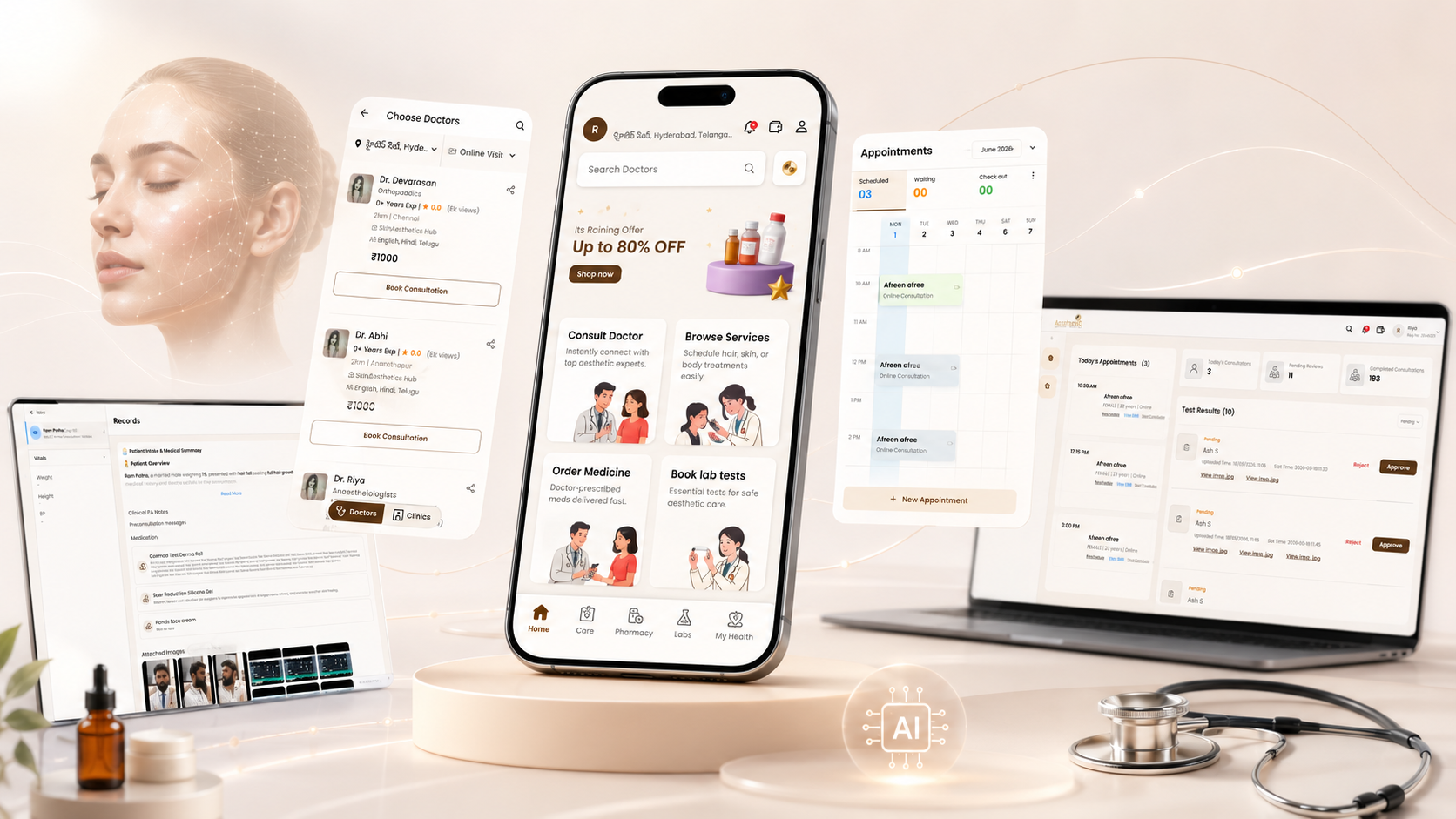
Building an AI-first aesthetic healthcare aggregator platform
A product ownership case study on designing an end-to-end healthcare aggregator for aesthetic
services, connecting skin and hair analysis, consultations, doctors, clinics, pharmacy,
diagnostics, procedures, inventory, follow-ups, and agentic workflows.
Aesthetic healthcare is operationally intense. Consultation, services, doctors, clinics, pharmacy, diagnostics, consent, inventory, procedures, and follow-ups all depend on each other. The challenge was to create a digital product that supports the business without confusing doctors, staff, or patients.
Outcome
The work helped create a clearer product roadmap where every feature was linked back to business revenue, operational efficiency, and user experience. My role was to bring clarity between clients, investors, business teams, and development teams.
Aesthetic healthcare aggregator ecosystem
Connecting patient care journeys, clinic operations, doctor workflows, pharmacy, diagnostics, services, inventory, and agentic AI support into one coordinated platform experience.
Platform scope
The product was not a single workflow. It was a healthcare business platform where software, services, operations, and revenue streams had to work together.
Patient experience
Hair and skin analysis
AI-supported flows for patient intake, analysis, consultation readiness, and service discovery.
Clinical network
Doctors and clinics
Onboarding multiple doctors and clinics while keeping workflows consistent and operationally usable.
Commerce and care
Services, pharmacy, diagnostics
Supporting service selling, pharmacy modules, diagnostic tests, and care-related revenue flows.
Agentic workflows
Operational AI support
Using agents to reduce doctor and staff time across checklists, prescriptions, consent, inventory, and follow-ups.
My role
My role is close to product ownership. I take requirements from clients, structure the roadmap, clarify MVP scope, validate priorities, and align the business, investors, clients, and development team around what should be built and why.
Translated client and business requirements into a clear product roadmap.
Created MVP scope, validation direction, and prioritization logic.
Aligned stakeholders across business, investors, clients, and development teams.
Connected each major function and feature back to revenue, operations, and user experience.
Protected the product from becoming a list of everything that feels mandatory.
Roadmap thinking
In this project, prioritization became one of the most important product responsibilities. Business teams may see everything as mandatory, but the product must still decide what creates value first.
01
MVP clarity
Identify the smallest useful version that proves value for the business, users, and operations.
02
Validation
Check whether the feature solves a real business or user problem before adding development weight.
03
Prioritization
Sequence features based on revenue impact, operational effort, user value, and development feasibility.
Agentic workflows
The agentic layer was designed to reduce time for doctors and clinical staff by handling preparation, checks, approvals, and follow-ups before or after the human touchpoint.
01Pre-consultation
Agents collect patient context, pre-consultation checklist inputs, and service consent.
02Service approval
Agents check with aesthetic service rules and approval requirements before the procedure.
03Inventory readiness
Agents check required inventory for the service so staff can prepare without last-minute confusion.
04Post-procedure
Agents support follow-ups, recovery touchpoints, retention, and post-surgery patient engagement.
Operations-first product thinking
This project made it very clear that healthcare digital experience is deeply connected to business operations. Pharmacy, consultation, diagnostics, and services are all operationally intense, so the product experience cannot ignore staff preparation, inventory, patient readiness, procedure approvals, and post-care retention.
The time of the doctor is critical. The product should not waste it with unclear inputs, missing preparation, or confusing workflows. A good digital experience must help the business run smoother while helping users complete their care journey.
Product decisions
Every feature must justify its value
When everything feels mandatory, prioritization becomes the product decision. I evaluate whether the feature supports revenue, operations, user experience, or development feasibility.
Agentic workflows should reduce human effort
Agents were considered where they could reduce doctor time, clinical staff coordination, repetitive checklist work, or follow-up effort.
Design for the complete business system
The platform needed to support not only screens, but also service readiness, inventory, pharmacy, diagnostics, procedure approvals, and retention.
Roadmap clarity creates alignment
Clear MVP and phased roadmap thinking helped align business teams, investors, clients, and developers around what should be built first.
Outcome
This case strengthened my product ownership skills. I learned to move beyond software delivery and think about how business operations, revenue streams, stakeholder expectations, doctor time, and staff workflows shape the digital experience.
It also helped me build stronger judgement around MVP, validation, and prioritization. The product roadmap became a way to make business and design decisions visible, not just a list of features to develop.
Key learnings
Healthcare aggregator products must connect software workflows with real business operations.
Agentic workflows are valuable when they reduce doctor time, staff effort, and operational confusion.
Prioritization matters most when every stakeholder sees their requirement as mandatory.
Each feature should connect back to revenue, operations, user experience, or measurable product value.